

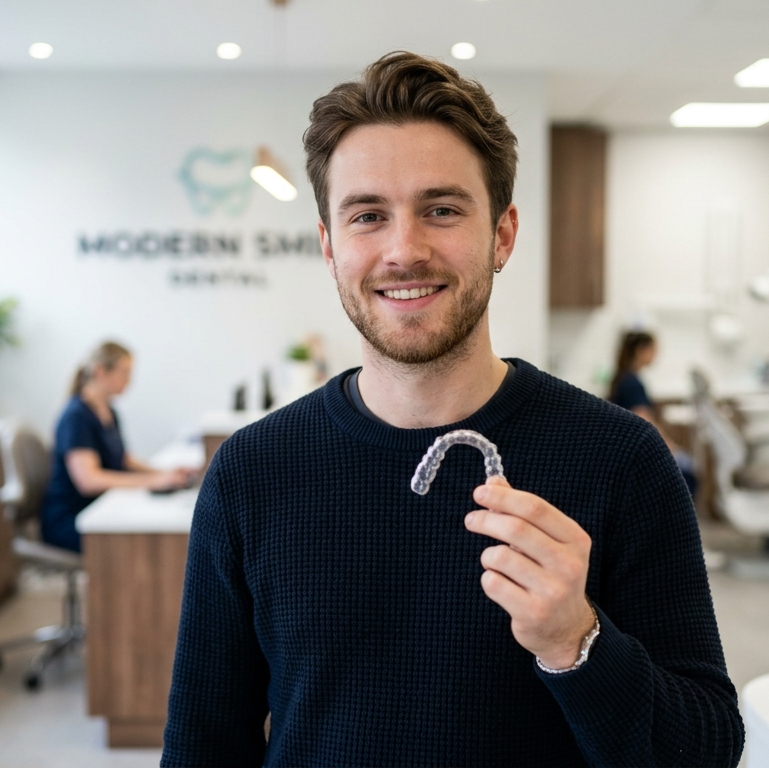

Your next patient is on Google
When someone searches for a dentist, dental implants, Invisalign or cosmetic dentistry in your area, will they find your practice — or a competitor's? We help your practice get found by more of the people searching for your treatments to turn searches into new patients.
Book a consultation
Your next patient is on Google
When someone searches for a dentist, dental implants, Invisalign or cosmetic dentistry in your area, will they find your practice — or a competitor's? We help your practice get found by more of the people searching for your treatments to turn searches into new patients.
Book a consultation
90%
Daily searches are on Google
69%
New patients come though Google
42%
Of patients leave if they can't find you
SOUND FAMILIAR?
How many of these sound like your practice?
“We're not getting enough new enquiries from Google.”
Patients are searching for implants and Invisalign. Your practice just isn't what they find.
"We rely too heavily on paid ads or social media.”
The enquiries stop the moment the spend does. Nothing you've built keeps working for you
“We're invisible in our local area.”
Patients search "dentist near me" and book whoever they see first. That should be you.
“We rank, but not for the treatments that pay.”
Traffic that never becomes the high-value private cases your practice actually wants.
“Competitors keep outranking us.”
The practices above you win the clicks and the bookings, month after month. That position is winnable.
“We're paying for SEO but not seeing any movement.”
Months of invoices, and the rankings look much the same as when you started.
We know what dental treatments your patients are searching for?
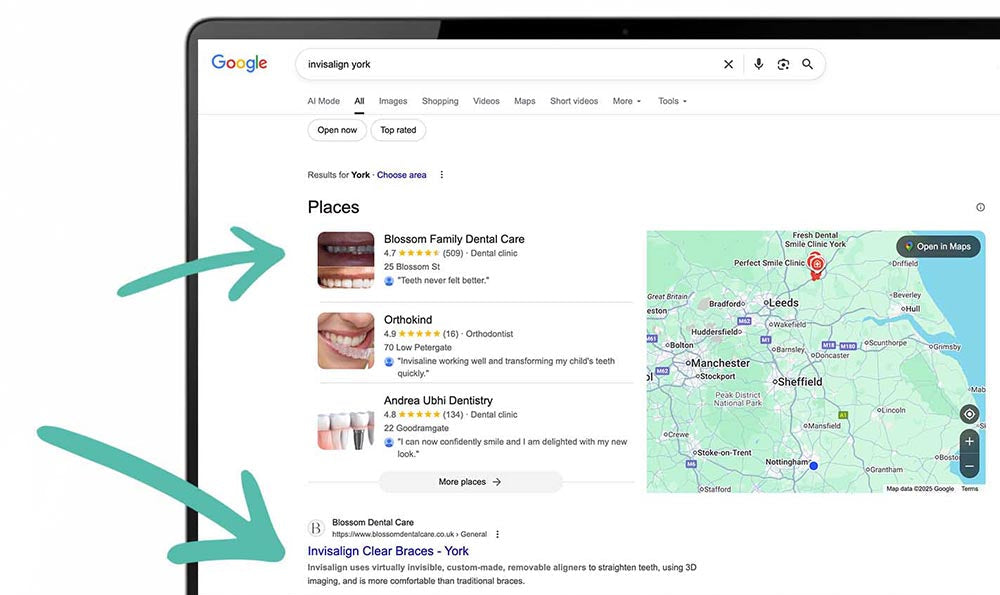
Position 1 gets twice the clicks of position 2
Google rewards the top result more than any other. Most patients never scroll past the first few, so a single place can cost your website half its traffic.
Which means second isn't nearly there. It's half the patients searching for your treatments booking with another practice — not because yours is worse, but because they saw someone else first. Close that one position and you're not gaining a little. You're doubling what Google sends your website.
Being on page one isn't the goal. Being 1st is.
OUR APPROACH
It starts with your business, not your keywords.
Strategy
Everything starts with your practice. What you want it to become, which treatments you want to grow, and which patients you want more of. Dental covers a wide spread — routine care keeps the diary full, but implants, Invisalign and cosmetic work
are usually where the growth sits.
From there the research begins. We find the search volumes behind those treatments, where you currently rank for them, and what it takes to close the gap. That tells us
the scale of the work, the timeframe, and the package that actually fits.
Optimisation
Then the work begins. Everything we found in the strategy gets acted on — closing the gap between where you rank now and where you need to be to win the searches that matter.
Not traffic for its own sake. The searches your patients are actually making for the treatments you want to grow, which is what turns rankings into bookings. It runs continuously rather than in bursts, because that's what holds a position once you've got it.
Reporting
Every target term, every position, tracked every month. You see exactly where you
rank, how it's moved, and which treatments are bringing the enquiries in.
Not a summary of activity, but the actual numbers — what climbed, what didn't, and
what it's worth to the practice. You see whether implants or Invisalign are pulling patients in, so you know where to push and what to grow next.
Review
Competition shifts, and dental demand moves through the year — cosmetic enquiries climb before summer and Christmas, routine care runs steadier. Some terms move fast, others take time.
Our reports cut through that to the real changes and the real results, so our team can sit down with you and go through what's working and what needs adjusting.
Everything is shared, discussed and easy to follow.
Everything starts with your practice. What you want it to become, which treatments you want to grow, and which patients you want more of. Dental covers a wide spread — routine care keeps the diary full, but implants, Invisalign and cosmetic work
are usually where the growth sits.
From there the research begins. We find the search volumes behind those treatments, where you currently rank for them, and what it takes to close the gap. That tells us
the scale of the work, the timeframe, and the package that actually fits.
Then the work begins. Everything we found in the strategy gets acted on — closing the gap between where you rank now and where you need to be to win the searches that matter.
Not traffic for its own sake. The searches your patients are actually making for the treatments you want to grow, which is what turns rankings into bookings. It runs continuously rather than in bursts, because that's what holds a position once you've got it.
Every target term, every position, tracked every month. You see exactly where you
rank, how it's moved, and which treatments are bringing the enquiries in.
Not a summary of activity, but the actual numbers — what climbed, what didn't, and
what it's worth to the practice. You see whether implants or Invisalign are pulling patients in, so you know where to push and what to grow next.
Competition shifts, and dental demand moves through the year — cosmetic enquiries climb before summer and Christmas, routine care runs steadier. Some terms move fast, others take time.
Our reports cut through that to the real changes and the real results, so our team can sit down with you and go through what's working and what needs adjusting.
Everything is shared, discussed and easy to follow.
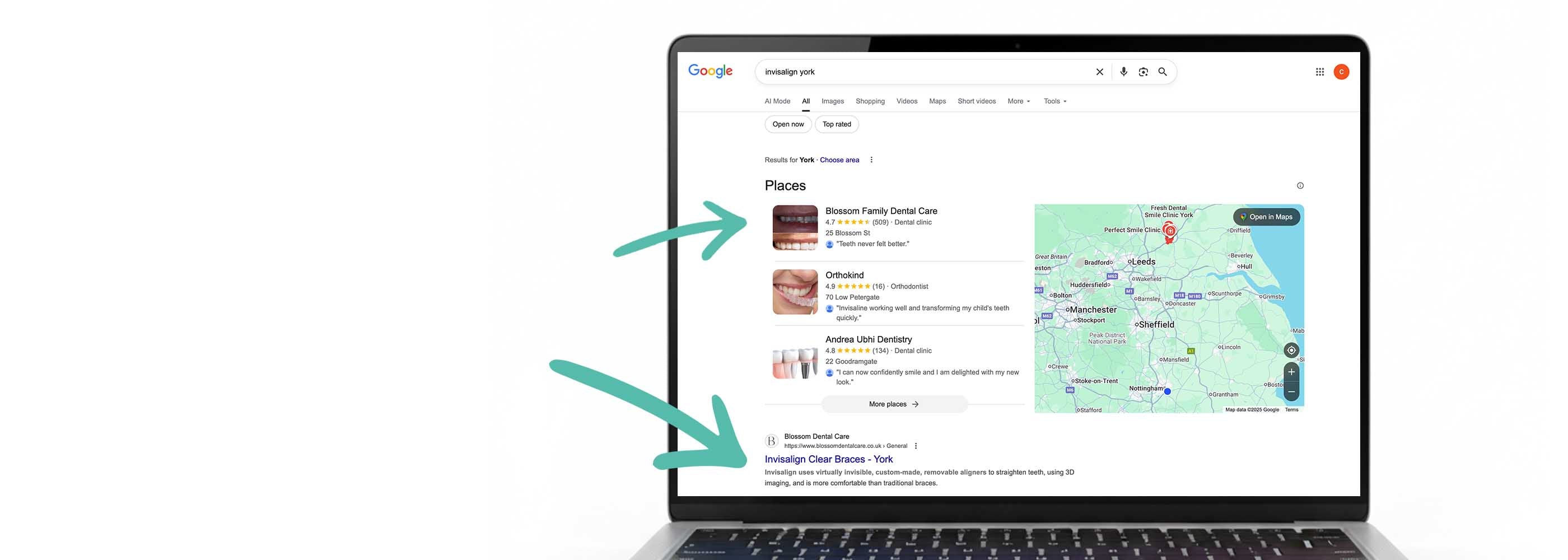
Blossom Family Dental Care

The Care Dental Practice

EVERYTHING FROM ON PAGE TO OFF PAGE SEO
Over 20 SEO features










DENTAL AEO
AI recommends Dentists and practices already ranking on Google.
AI assistants don't invent their answers. They pull from the pages already ranking
well, so the same work that gets you to the top of Google is the work that gets your practice named by ChatGPT, Gemini and Claude. Same foundations, two places
your patients are now looking.
Cited sources
AI answers quote the pages they trust most, and trust starts with ranking. Our team gets your practice into the results AI is reading, so yours is the name it repeats.
Structured data
Clean schema makes your treatments legible to search engines and AI alike. We build it in from the start, so nothing about your practice gets misread or missed.
Authority & trust
Links, reviews and reputation tell Google and AI the same thing: this is the credible choice. We build all three, month after month, so your clinic reads as the safe pick in both.
PROOF, NOT PROMISES
Results we've delivered
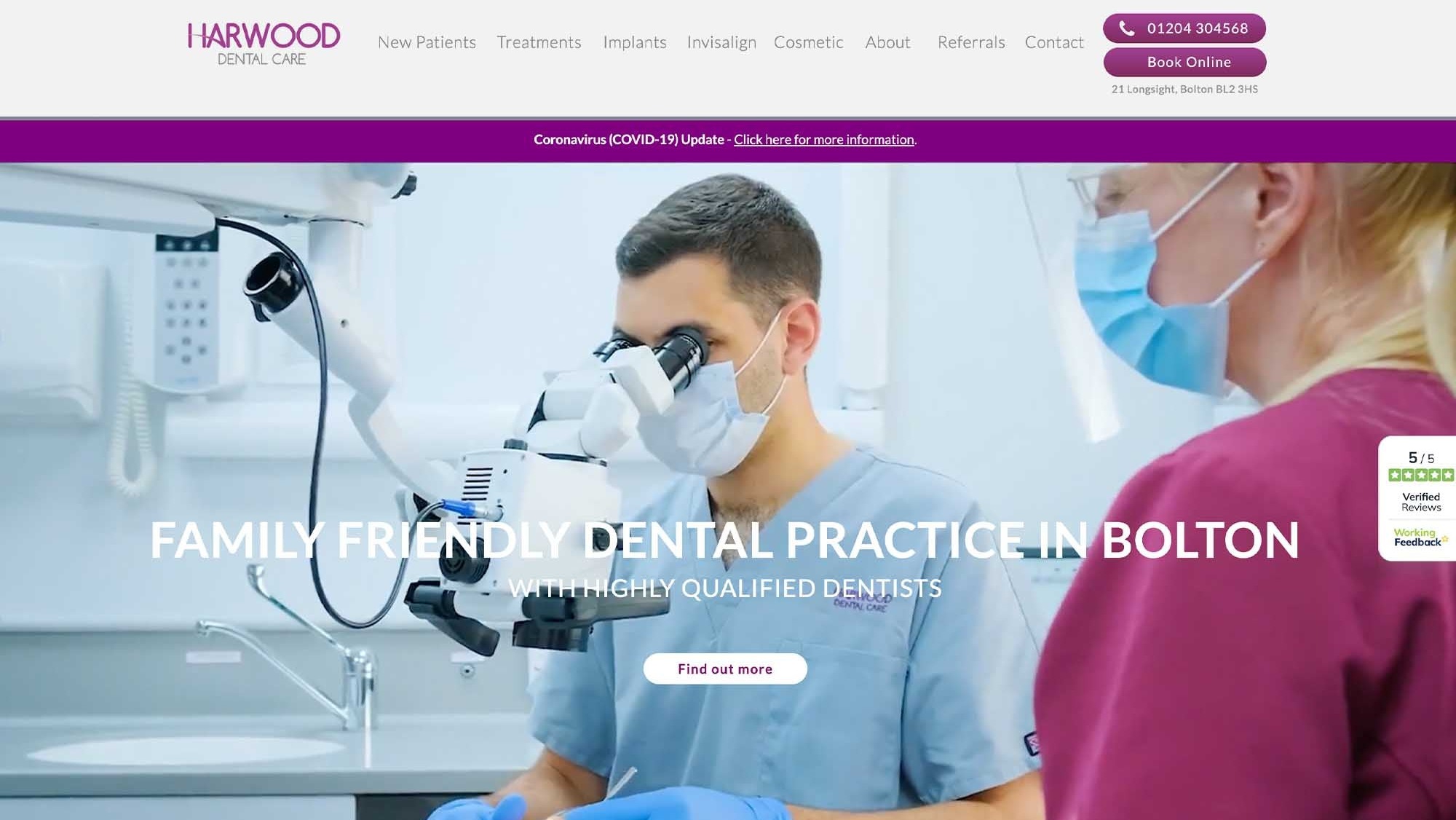
Now first on Google for private dentist near me.
Harwood Dental Care
Website visits up 30% in a single month.
Claregate Dental
New patient enquiries up 143% in three months.
Harwood Dental Care
“I’m so delighted with the new website — it really feels how I imagined and hoped it would be.”


SEO FAQs
We're happy to talk through how SEO can help your clinic grow.
Why isn't my current SEO bringing in new patients?
Usually because it's chasing the wrong things. Plenty of dental SEO targets broad terms like "dentist" that carry big volume and bring in patients you may not want — NHS enquiries when you're building private, or routine check-ups when the growth is in implants. Rankings without the right enquiries means the strategy was built around search engine optimisation for its own sake rather than around your treatments.
We start with your practice — the treatments you want to grow and the patients you want more of — then find the keywords those patients actually search for. Someone typing "does teeth whitening hurt" is reading. Someone typing "dental implants cost near me" is booking.
How does SEO help my practice grow, not just rank higher?
Ranking is the means, not the end. Good dental SEO targets the treatment keywords that carry real commercial value, so the patients arriving are ready to book rather than researching casually. Implants, Invisalign, veneers and composite bonding are usually where the strongest return sits.
It also compounds. Unlike paid ads, where enquiries stop the moment the spend does, search engine optimisation builds authority that keeps working. The rankings you earn for dental implants this year still bring in patients next year.
I already have a website. Will SEO still make a difference?
Almost always. Most dental websites are built to look right, not to rank. The treatment pages exist, but they're not structured around what patients search for, and the technical foundations underneath are usually costing rankings without anyone knowing.
SEO works with what you have. We optimise the pages you've got, build the ones you're missing, fix the technical issues holding you back, and add the schema that helps Google and AI understand your treatments. The site stays yours. It just starts earning.
What makes your clinic SEO approach different?
We don't limit the work. No caps on keywords, no scope conversations, no asking you which terms to target — that's our job. If dental implants need ten pages to compete properly in your area, they get ten.
We also understand the NHS and private split. If you're building private treatment revenue, ranking for general dental terms brings in the wrong enquiries and fills the diary with the wrong appointments. The targeting has to reflect the practice you're trying to become, not just the one you are.
How long before I see more patient enquiries?
Local SEO and Google Business Profile work can move within weeks, particularly for "dentist near me" searches where competition is lighter. Competitive treatment keywords like dental implants take longer — typically three to six months for meaningful movement, depending on where you're starting and who you're up against.
You'll see progress long before the headline numbers move. We track every target keyword's position monthly, so you know which treatments are climbing and where the enquiries are coming from well before the diary reflects it.
Can you target specific treatments or locations?
Yes, and it's how dental SEO should work. We build the strategy around the treatments you want to grow and the areas you want patients from — one location or several, implants alone or your full treatment list.
Location matters a great deal in dental, because patients want a practice they can get to easily and return to regularly. We optimise your Google Business Profile, local listings and location pages for "treatment + area" searches, which is where the shortest distance between finding you and booking sits.
What happens if my rankings drop?
Rankings respond quickly to the work — usually within weeks. We track every target keyword monthly, so we see exactly what's climbing, what's slipped, and what's stubborn and needs more behind it. Movement in all directions is normal, and the more competitive your area, the more normal it gets.
The reasons vary. Some terms need more SEO before they hold. Some are still being assessed by Google. Some move because a competitor invested that month. If something keeps trending down, the reports do their job — we spot it immediately, change course, or put more time where it's needed.
What happens after I start SEO with Cosmetic Digital?
We begin with strategy — your growth plans, the treatments you want to grow, and where you currently rank for them. That research tells us the scale of the work and the timeframe before anything gets changed.
Then the optimisation runs continuously: on-page and off-page SEO, content, links, technical health and local search. You get monthly reporting on every target keyword, and regular reviews with our team to look at what's working and what needs adjusting.
Book an SEO consultation
A free 30 minute consultation for your dental practice to understand your business goals, the patients you want to target, and the budget you're working with - we'll do the rest.